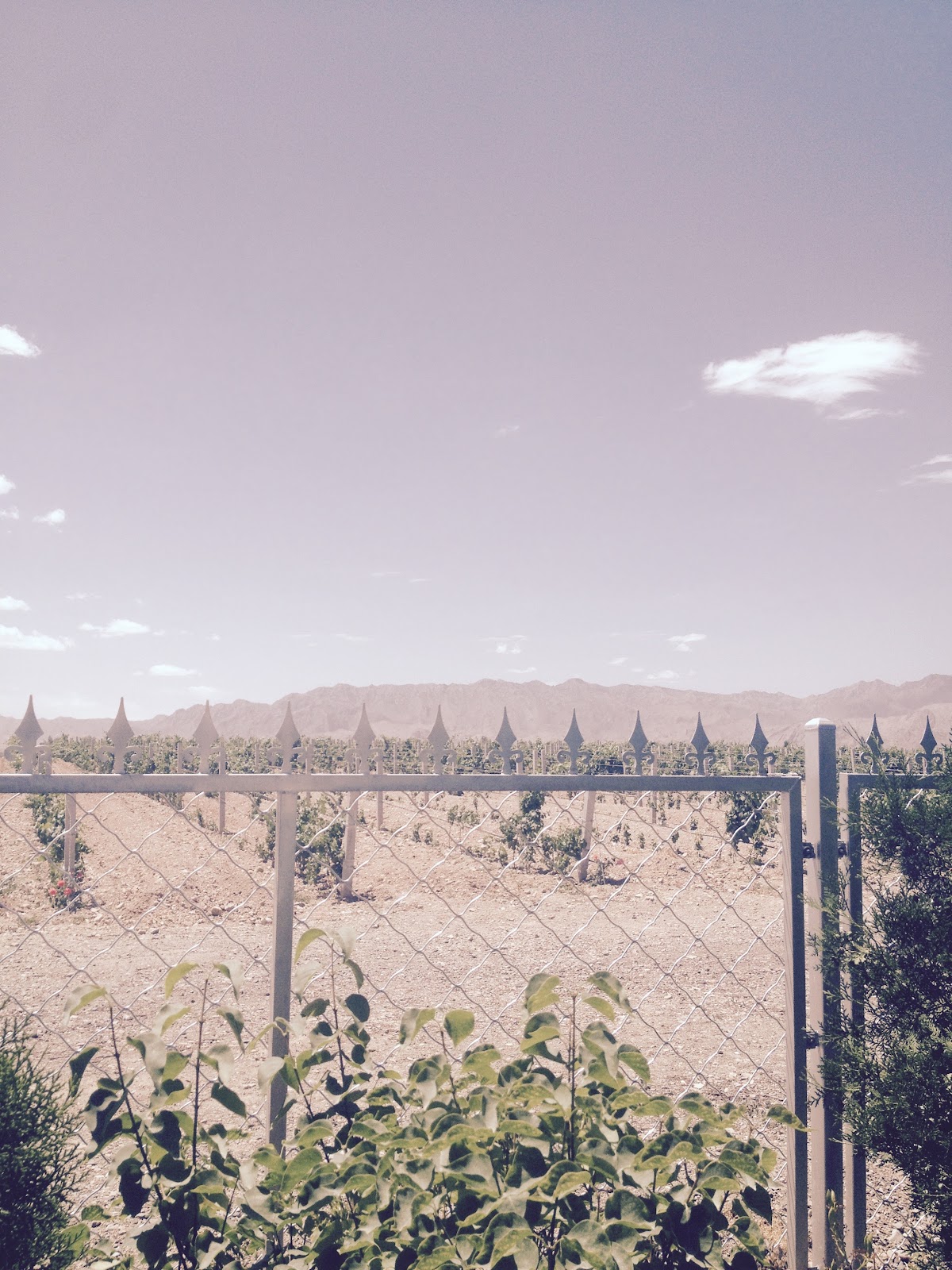
After much debate on the best way to spend our last morning in Ningxia - to hedge bets & stay near the city, visiting Silver Height's original facility before our flight or get an early start & venture an hour toward the mountains to their new location built in 2014. We chose the latter & were well rewarded for our sense of adventure. From very little on the way to the next village to the sudden bustle around the local tourist attraction, a film studio used for many period movies; and back to almost nothing; right at the wooden watch tower & we were there. There being a large red low warehouse-like building, 8 times the size of the facility in the city.
We were met by a bubbly American, Alexa, who heads up marketing & communications. An interesting contrast to our previous experiences, with fast flowing English and outsider insights into the industry. Winemaker, Emma, shared extremely insightful anecdotes around both the industry - both past & present. From government controls over varietals imported (explaining the high concentration of Bordeaux varietals), to terroir, pricing to recover costs of setting up wineries by the current generation & the Gold Rush for land in Ningxia.
Silver Heights began as a bit of a premonition on the part of winemaker, Emma's, father. He planted the first vines in the area, with the belief that there was potential for successful winemaking, and promptly shipped Emma off to Bordeaux to study winemaking in 1999 where she met husband, Thierry, who returned to China with her. Husband & wife team are now responsible for the increasingly well-reputed wines thanks to Emma's previous employer, a wine distributor, who told her to bugger off & make wine full time after tasting some of what she was making in her spare time.
And it's easy to see why.
From a floral yet fresh Chardonnay (the first release), to beautifully structured & layered reds - The Summit (Cab Sauv, Shiraz, Merlot blend) being described by dear Jancis Robinson as "just the wine to confound prejudices".
And, overall, the wine we experienced in China did just that. Ganbei, Ningxia!
An uneducated, uncensored, very biased foray into the wonderful world of the (mostly) South African wine.
Friday, 14 October 2016
Sticks & Stones & Vines at Yuanshi
As the day drew to a close, we had one final stop ahead - the first our driver was actually certain of the location of.
Also, certainly the most beautiful we had visited to date. The chateau, the largest in the region, is a tribute to the owner's (who never drinks a drop of wine) love for rock & stone, showcased in a multitude of forms. From the buildings themselves, to intricate carvings & artworks tastefully dotted throughout; and soon to include a rock museum as well. Construction on the chateau began in 2008, to be completed in 2014. This seems an awfully long time on paper, but a walk through the winery & surrounds quickly reveals the extreme attention to detail, accounting for the time spent. From stone & rock collected throughout China, to ceilings lined with interwoven twigs to buffer sound & boundary walls constructed from rounded tiles to allow birds to nest.
Accompanied by winemaker, Sujie, we toured the production facility, comprising only machinery imported from Italy; the extensive cellar & private cellaring for clients who purchase whole barrels & bottle with their own labels; through a number of tasteful displays to the tasting room where the ceiling is crafted from the skeleton of the hull of an old ship, with the tables & chairs crafted from the same wood.
Here, we tasted through a lovely, bronze Decanter winning unoaked Chardonnay, of which very little was bottled due to limited demand for white wine in the local market (the rest of the harvest was used for brandy production); a 2013 Cab Sauv with a spot of 2014 added to perk it up; the estate's flagship red blend, Soul Mountain (Cab Sauv, Cab Franc & Merlot); and a very interesting private project of Sujie's - an unfiltered & unfined Cab Sauv 2014 of which only 800 bottles were produced. While we were delighted at Te honour & impressed by each wine in turn, Sujie remained critical of her work.
We felt this was a fantastic end to a fascinating & highly rewarding day. We looked forward to day 3.
Also, certainly the most beautiful we had visited to date. The chateau, the largest in the region, is a tribute to the owner's (who never drinks a drop of wine) love for rock & stone, showcased in a multitude of forms. From the buildings themselves, to intricate carvings & artworks tastefully dotted throughout; and soon to include a rock museum as well. Construction on the chateau began in 2008, to be completed in 2014. This seems an awfully long time on paper, but a walk through the winery & surrounds quickly reveals the extreme attention to detail, accounting for the time spent. From stone & rock collected throughout China, to ceilings lined with interwoven twigs to buffer sound & boundary walls constructed from rounded tiles to allow birds to nest.
Accompanied by winemaker, Sujie, we toured the production facility, comprising only machinery imported from Italy; the extensive cellar & private cellaring for clients who purchase whole barrels & bottle with their own labels; through a number of tasteful displays to the tasting room where the ceiling is crafted from the skeleton of the hull of an old ship, with the tables & chairs crafted from the same wood.
Here, we tasted through a lovely, bronze Decanter winning unoaked Chardonnay, of which very little was bottled due to limited demand for white wine in the local market (the rest of the harvest was used for brandy production); a 2013 Cab Sauv with a spot of 2014 added to perk it up; the estate's flagship red blend, Soul Mountain (Cab Sauv, Cab Franc & Merlot); and a very interesting private project of Sujie's - an unfiltered & unfined Cab Sauv 2014 of which only 800 bottles were produced. While we were delighted at Te honour & impressed by each wine in turn, Sujie remained critical of her work.
We felt this was a fantastic end to a fascinating & highly rewarding day. We looked forward to day 3.
Tuesday, 27 September 2016
Jubilant Jing's Jia Bein Lan
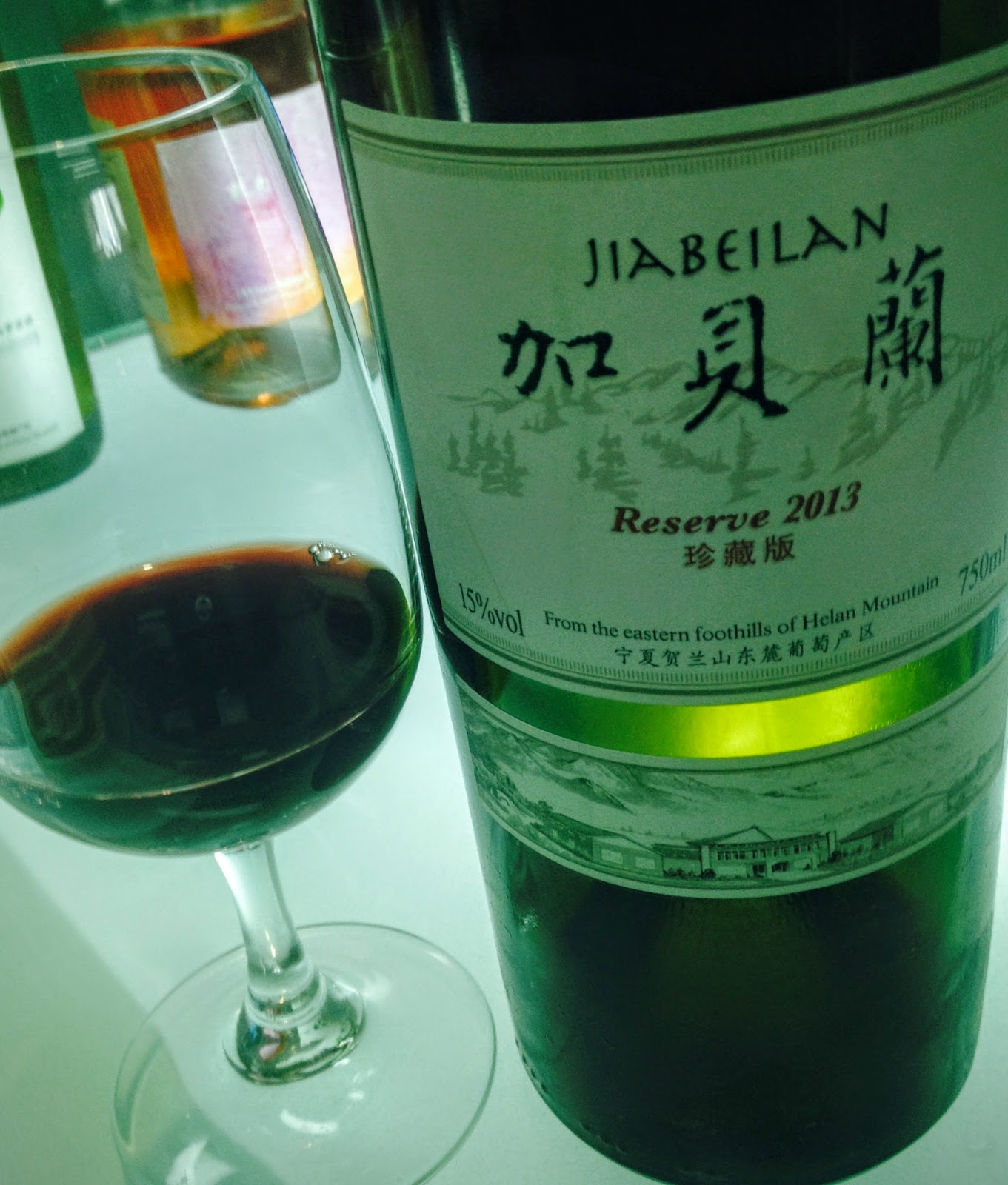
Named after a poem about 1 of the 8 revered landscapes of the Ming Dynasty, Helan Qingxue claims the best view of this landscape at the foot of the Helan Mountains. Established in 2005 by a viticulturist, winemaker & business manager, the winery was the first in China to win an international accolade in 2011 in the form of a Decanter International Trophy. The wines, called Jia Bei Lan or "Little Feet" in honour of the birth of dynamic winemaker, Jing's daughter, have continued to grow from strength to strength since with growing export opportunities & a stream du stream of praise from international wine lovers. All of this we learned from the obligatory corporate video with a few added facts from Jing herself.
Our host was happy to meet South Africans after playing host to a South African winemaker in 2012 during the inaugural Ningxia International Wine Challenge - a competition created & funded by the local government with a little help from the participating wineries, which allows a selection of winemakers from across the globe to produce a vintage of Cabernet Sauvignon over 2 years with a cash prize awarded to the wine judged as best. There are 3 South African participants in the current challenge.
We toured the again, immaculate cellar, tasting the new vintage of entry-level Cab on its way to bottle as we made our way around; passing locally made bee-hive shaped tanks (which Jing was the first to use due the shape being ideal for red maceration) & barrels signed by the many notable international visitors while discussing the enthusiasm of Chinese wine-lovers to gain their WSET Level 4 qualifications, with over 20 Level 4 graduates to date.
This led us to the Cellardoor which is set to launch in the next year including a simple food offering. Lined up to taste, we had an unwooded Chardonnay in a Riesling bottle (tinned peas & lime on the nose with apricots & citrus on the palate); a Cab Franc Rosé (slightly sweet despite its savoury nose); a Cab Merlot blend (Moroccan spice & grippy tannins); & a Reserve Cab (eucalyptus & light violets). Again - all Bordeaux varietals. From Jing's perspective, these are the best varietals for the area which requires grapes with a short growing period to allow sufficient time for the vines to rest after harvest, before being buried for winter (an activity which accounts for 30% of the production cost of the wine). Thoroughly enamoured with the wines, the winery & the winemaker, it was unfortunately time for us to bid farewell. No time for us to rest; our next stop beckoned.
Our host was happy to meet South Africans after playing host to a South African winemaker in 2012 during the inaugural Ningxia International Wine Challenge - a competition created & funded by the local government with a little help from the participating wineries, which allows a selection of winemakers from across the globe to produce a vintage of Cabernet Sauvignon over 2 years with a cash prize awarded to the wine judged as best. There are 3 South African participants in the current challenge.
We toured the again, immaculate cellar, tasting the new vintage of entry-level Cab on its way to bottle as we made our way around; passing locally made bee-hive shaped tanks (which Jing was the first to use due the shape being ideal for red maceration) & barrels signed by the many notable international visitors while discussing the enthusiasm of Chinese wine-lovers to gain their WSET Level 4 qualifications, with over 20 Level 4 graduates to date.
This led us to the Cellardoor which is set to launch in the next year including a simple food offering. Lined up to taste, we had an unwooded Chardonnay in a Riesling bottle (tinned peas & lime on the nose with apricots & citrus on the palate); a Cab Franc Rosé (slightly sweet despite its savoury nose); a Cab Merlot blend (Moroccan spice & grippy tannins); & a Reserve Cab (eucalyptus & light violets). Again - all Bordeaux varietals. From Jing's perspective, these are the best varietals for the area which requires grapes with a short growing period to allow sufficient time for the vines to rest after harvest, before being buried for winter (an activity which accounts for 30% of the production cost of the wine). Thoroughly enamoured with the wines, the winery & the winemaker, it was unfortunately time for us to bid farewell. No time for us to rest; our next stop beckoned.
A Lot of Luck at Legacy Peak
Legacy Peak, our next stop, could not be more of a contrast to Changyu. Simple & understated, the only show of pomp being a row of empty wine bottles from around the world which the director prized (including a Vilafonte Series C 2008) & a small plate of Iberian ham on the table laid out for our tasting. There was even shock at the idea of not being allowed to taste when we enquiries whether there would, indeed, be wine on the cards.
The first winery in the area to export their wines, Legacy Peak is also the oldest vineyard in the Ningxia province with vines planted in 1996, set amongst the 1000 year old Xixia King Tombs. This certainly adds to the scenery but puts the vines & expansion plans at risk should the government go ahead with plans to reclaim the land the farm occupies. Not that there isn't enough risk as is with the icy cold winters - every year approximately 20 - 30% of vines up to 6 years of age don't survive despite being bent over & buried up to the first trellis line. Sometimes all that survives are the cement posts - preferred to wood as they're cheaper, easily available & last longer than the traditional wooden posts. The 450 mu (approximately 3,75 ha) of organic vines sit at 1246m above sea level & consist mainly of - you guessed it - Bordeaux varietals Chardonnay, Merlot & Cabernet Sauvignon with a spot of a French hybrid grape, Marselan (a combination of Cab Sauv & Grenache). There's also a sense here that China is still finding its feet with which varietals are best suited to the land and what the defining characteristic of Chinese wine will be.
We dutifully set about exploring this. The Chardonnay beautifully floral on the nose with fresh litchi & elegant citrus on the palate; the rosé a little sweet (thanks, market) tinged with geraniums; the Cabernets - estate & flaghip, Kalavinka, both bold with slightly spicy red fruits & not afraid of ageing.
We further explored, with many toasts, over a generous lunch of local lamb with the team. We were back in luck, twice over.
The first winery in the area to export their wines, Legacy Peak is also the oldest vineyard in the Ningxia province with vines planted in 1996, set amongst the 1000 year old Xixia King Tombs. This certainly adds to the scenery but puts the vines & expansion plans at risk should the government go ahead with plans to reclaim the land the farm occupies. Not that there isn't enough risk as is with the icy cold winters - every year approximately 20 - 30% of vines up to 6 years of age don't survive despite being bent over & buried up to the first trellis line. Sometimes all that survives are the cement posts - preferred to wood as they're cheaper, easily available & last longer than the traditional wooden posts. The 450 mu (approximately 3,75 ha) of organic vines sit at 1246m above sea level & consist mainly of - you guessed it - Bordeaux varietals Chardonnay, Merlot & Cabernet Sauvignon with a spot of a French hybrid grape, Marselan (a combination of Cab Sauv & Grenache). There's also a sense here that China is still finding its feet with which varietals are best suited to the land and what the defining characteristic of Chinese wine will be.
We dutifully set about exploring this. The Chardonnay beautifully floral on the nose with fresh litchi & elegant citrus on the palate; the rosé a little sweet (thanks, market) tinged with geraniums; the Cabernets - estate & flaghip, Kalavinka, both bold with slightly spicy red fruits & not afraid of ageing.
We further explored, with many toasts, over a generous lunch of local lamb with the team. We were back in luck, twice over.
A Chateau in China - Visiting Changyu Moser VIII
Bellies full of noodles, we were ready for an 08:00 start at Changyu's Chateau Moser XIII. The Chateau was named in honour of Mr Moser XIII, the pioneer of trellising, and grandson Lenz Moser XV currently stands as chief winemaker. Moser is one of 6 chateaux in China, 2 in France & 1 each in Italy, Spain & New Zealand.
And they're not kidding about the chateau part. Changyu's founder, who brought wine vines to China in 1892, went on to win a gold medal at the international exhibition held in San Francisco in 1915 at the opening of the Panama Canal. The flair for showmanship has lived on. Moser boasts an in house theatre; museum; an interactive wine education centre where you can test your smell recognition, learn about taste receptors & pair varietals with foods; and of course an imitation ship to celebrate that gold medal.
You can custom label your own wine bottle, take wedding photos, grab a bite at the restaurant & stroll through the gardens while the endless staff of lovely young ladies in old fashioned green dresses with lace cuffs & collars flutter around.
But you cannot taste more than 1 wine - an average medium-tier red blend. Not without a conversation with the director. We feared we were truly out of luck.
And they're not kidding about the chateau part. Changyu's founder, who brought wine vines to China in 1892, went on to win a gold medal at the international exhibition held in San Francisco in 1915 at the opening of the Panama Canal. The flair for showmanship has lived on. Moser boasts an in house theatre; museum; an interactive wine education centre where you can test your smell recognition, learn about taste receptors & pair varietals with foods; and of course an imitation ship to celebrate that gold medal.
You can custom label your own wine bottle, take wedding photos, grab a bite at the restaurant & stroll through the gardens while the endless staff of lovely young ladies in old fashioned green dresses with lace cuffs & collars flutter around.
But you cannot taste more than 1 wine - an average medium-tier red blend. Not without a conversation with the director. We feared we were truly out of luck.
Welcome to the Winelands - China Day 1
Arriving in Yinchuan, Ningxia with a plan to visit wineries (which we had a loose idea of the location of) but no confirmed way of actually getting to them without paying the rather ridiculous amount quoted for a driver turned out to be no problem. A helpful tour guide, with a passable grip on English, at the train station offered to drive us to our hotel & was easily convinced to spend the next 3 days ferrying us around; starting with a local spot for a breakfast of hand-pulled noodles.
Next stop - Pernod Ricard's Helan Mountain. Kitted in our luminous orange safety vests, we toured the immaculately clean & well ordered production facility which is undergoing extensive expansion to include a visitor centre. One of the older wineries in Ningxia, the majority of the vines, which are spread across 3 sites in the area, were planted in 1997 with a strong focus on Cabernet Sauvignon accompanied by small pockets of Chardonnay & Merlot - typical Bordeaux varietals which seemed a little counter intuitive given the hot, dry conditions. Winemaker, Linda has been with the farm for 16 years with frequent exchanges to New Zealand & Australia. While Cab is the driving force at the winery based on consumer demand, she believes there is scope for experimentation - an idea strongly agreed with by Kiwi viticulturist, Mike Insley, whom we met with the next evening. Where Linda is most concerned with the balancing act of harvesting late enough to ensure phenolic ripeness (mostly the bit that makes your wine smell like lovely things) before the vines have to be buried for the winter (yup - we learned that's a thing in the area; more about that later), Mike is facing the challenge of a serious shortage of labour in the coming years thanks to repercussions of the one child policy & urbanisation. Never a dull moment, it seems.
But back to important matters - there was wine to be tasted. In the form of 3 barrel samples of the Helan Mountain Reserve range Chardonnay, Merlot & Cab. We were more than pleasantly surprised. The wines all had more time to spend in barrel but each one was showing great potential. From the floral prettiness of the Chard to the already gentle profile of the Cab, we certainly were off to a great start in China.
Unfortunately, our luck seemed to have maxed out for the day. Our next stop would not deliver as we'd hoped. While extremely impressive, with architecture reflecting the vineyards in winter when they are little more than undulating ground with trellising posts poking out; not being able to taste any of the wines despite purchasing left much to be desired from our Chandon China experience.
Perhaps our luck would return tomorrow, we hoped over a late lunch of noodles.
Next stop - Pernod Ricard's Helan Mountain. Kitted in our luminous orange safety vests, we toured the immaculately clean & well ordered production facility which is undergoing extensive expansion to include a visitor centre. One of the older wineries in Ningxia, the majority of the vines, which are spread across 3 sites in the area, were planted in 1997 with a strong focus on Cabernet Sauvignon accompanied by small pockets of Chardonnay & Merlot - typical Bordeaux varietals which seemed a little counter intuitive given the hot, dry conditions. Winemaker, Linda has been with the farm for 16 years with frequent exchanges to New Zealand & Australia. While Cab is the driving force at the winery based on consumer demand, she believes there is scope for experimentation - an idea strongly agreed with by Kiwi viticulturist, Mike Insley, whom we met with the next evening. Where Linda is most concerned with the balancing act of harvesting late enough to ensure phenolic ripeness (mostly the bit that makes your wine smell like lovely things) before the vines have to be buried for the winter (yup - we learned that's a thing in the area; more about that later), Mike is facing the challenge of a serious shortage of labour in the coming years thanks to repercussions of the one child policy & urbanisation. Never a dull moment, it seems.
But back to important matters - there was wine to be tasted. In the form of 3 barrel samples of the Helan Mountain Reserve range Chardonnay, Merlot & Cab. We were more than pleasantly surprised. The wines all had more time to spend in barrel but each one was showing great potential. From the floral prettiness of the Chard to the already gentle profile of the Cab, we certainly were off to a great start in China.
Unfortunately, our luck seemed to have maxed out for the day. Our next stop would not deliver as we'd hoped. While extremely impressive, with architecture reflecting the vineyards in winter when they are little more than undulating ground with trellising posts poking out; not being able to taste any of the wines despite purchasing left much to be desired from our Chandon China experience.
Perhaps our luck would return tomorrow, we hoped over a late lunch of noodles.
Subscribe to:
Posts (Atom)