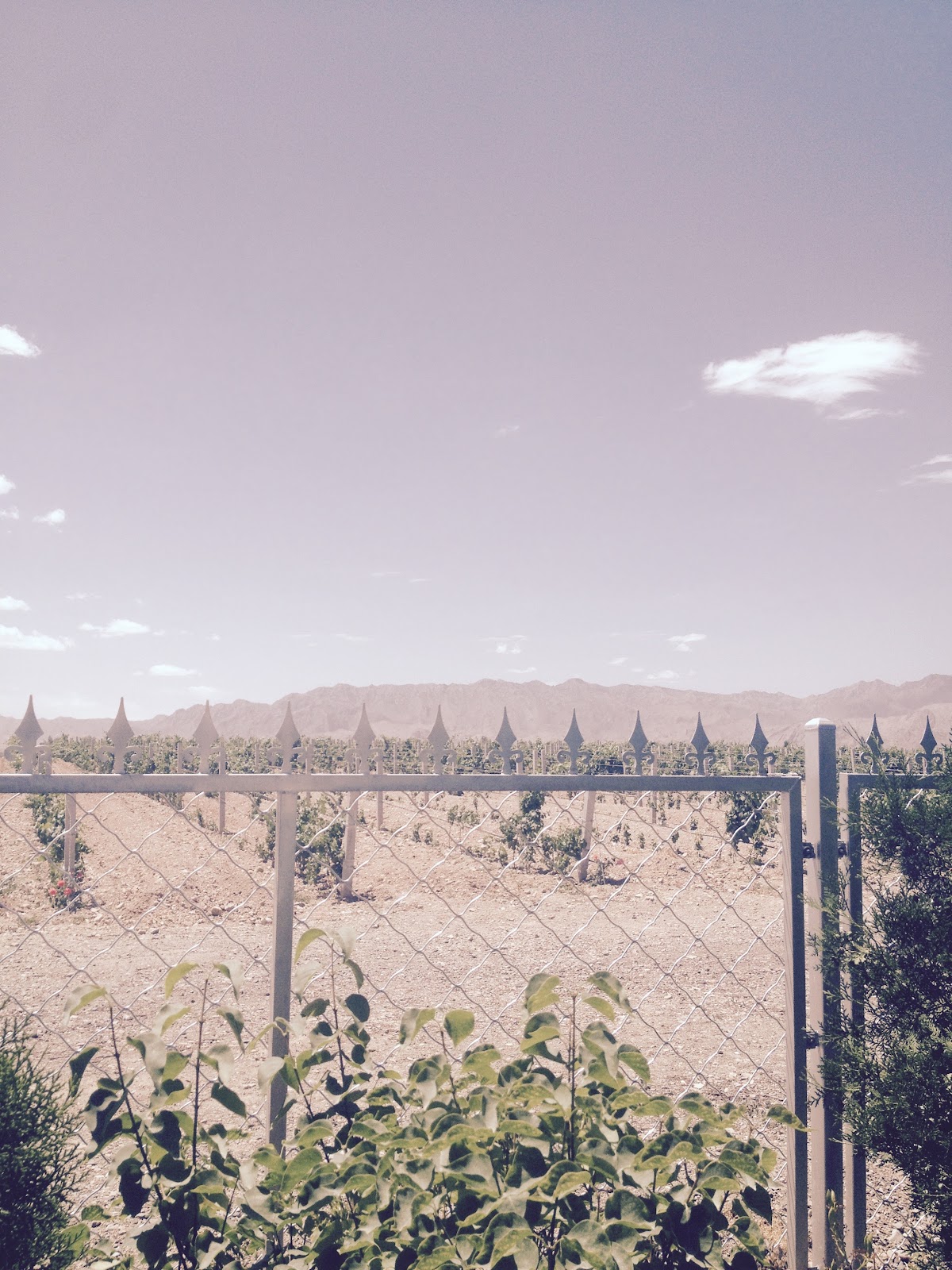
Arriving in Yinchuan, Ningxia with a plan to visit wineries (which we had a loose idea of the location of) but no confirmed way of actually getting to them without paying the rather ridiculous amount quoted for a driver turned out to be no problem. A helpful tour guide, with a passable grip on English, at the train station offered to drive us to our hotel & was easily convinced to spend the next 3 days ferrying us around; starting with a local spot for a breakfast of hand-pulled noodles.
Next stop - Pernod Ricard's Helan Mountain. Kitted in our luminous orange safety vests, we toured the immaculately clean & well ordered production facility which is undergoing extensive expansion to include a visitor centre. One of the older wineries in Ningxia, the majority of the vines, which are spread across 3 sites in the area, were planted in 1997 with a strong focus on Cabernet Sauvignon accompanied by small pockets of Chardonnay & Merlot - typical Bordeaux varietals which seemed a little counter intuitive given the hot, dry conditions. Winemaker, Linda has been with the farm for 16 years with frequent exchanges to New Zealand & Australia. While Cab is the driving force at the winery based on consumer demand, she believes there is scope for experimentation - an idea strongly agreed with by Kiwi viticulturist, Mike Insley, whom we met with the next evening. Where Linda is most concerned with the balancing act of harvesting late enough to ensure phenolic ripeness (mostly the bit that makes your wine smell like lovely things) before the vines have to be buried for the winter (yup - we learned that's a thing in the area; more about that later), Mike is facing the challenge of a serious shortage of labour in the coming years thanks to repercussions of the one child policy & urbanisation. Never a dull moment, it seems.
But back to important matters - there was wine to be tasted. In the form of 3 barrel samples of the Helan Mountain Reserve range Chardonnay, Merlot & Cab. We were more than pleasantly surprised. The wines all had more time to spend in barrel but each one was showing great potential. From the floral prettiness of the Chard to the already gentle profile of the Cab, we certainly were off to a great start in China.
Unfortunately, our luck seemed to have maxed out for the day. Our next stop would not deliver as we'd hoped. While extremely impressive, with architecture reflecting the vineyards in winter when they are little more than undulating ground with trellising posts poking out; not being able to taste any of the wines despite purchasing left much to be desired from our Chandon China experience.
Perhaps our luck would return tomorrow, we hoped over a late lunch of noodles.
An uneducated, uncensored, very biased foray into the wonderful world of the (mostly) South African wine.
Tuesday, 27 September 2016
The China Planning Challenge
The fact that wine is produced in China seemed a bit of a shock to most people outside of China. And, seemingly, most people we encountered in China, even those in one of the most concentrated wine producing regions. At times, based on the hassle to arrange visits to the wineries, I was almost convinced it came as a shock to the wineries themselves.
Don't let that put you off though - I will say that the wine was worth the hassle in the end. Most of it, at least.
As I've subtly hinted before, planning a trip is not quite as simple as doing a quick Google search. China is massively vast. Ridiculously so, meaning wine regions are also ridiculously far apart. Where to start? We grabbed the Asian Wine Review & plotted which area had the highest concentration of award-winning wineries (will AWR become the Platter Guide of Asia?). This extremely scientific approach led us to the city of Yinchuan in the Ningxia province - a finger of desert sticking into Inner Mongolia alongside the Helan Mountain range. That was part was easy. Finding contact details & planning an itinerary, however, was not. A 3-day itinerary eventually came to light through multiple emails; cold-calling wine writers; WeChats to winemakers, professors, tour guides; & endless map guesswork.
At last, with a few days to spare & no means of getting to & between the wineries, we were set to board the train & taste some wine - or so we thought...
Don't let that put you off though - I will say that the wine was worth the hassle in the end. Most of it, at least.
As I've subtly hinted before, planning a trip is not quite as simple as doing a quick Google search. China is massively vast. Ridiculously so, meaning wine regions are also ridiculously far apart. Where to start? We grabbed the Asian Wine Review & plotted which area had the highest concentration of award-winning wineries (will AWR become the Platter Guide of Asia?). This extremely scientific approach led us to the city of Yinchuan in the Ningxia province - a finger of desert sticking into Inner Mongolia alongside the Helan Mountain range. That was part was easy. Finding contact details & planning an itinerary, however, was not. A 3-day itinerary eventually came to light through multiple emails; cold-calling wine writers; WeChats to winemakers, professors, tour guides; & endless map guesswork.
At last, with a few days to spare & no means of getting to & between the wineries, we were set to board the train & taste some wine - or so we thought...
Tuesday, 26 July 2016
Vino in Vietnam
With our wine consumption mainly limited to 6 winery visits over 2 months, with a few bottles which had made their way from South Africa in between (notably a bottle of Luddite Shiraz 2009 consumed at an altitude of 3900m in Nepal); Vietnam was a veritable playground of wine. Actually, more of an overpriced theme park due mainly to tax & transport costs - but there was decent wine & we were very happy to spend a little more than the quality deserved for the pleasure.
While not actually producing any wine that we could track down, the wine drinking culture was much stronger than we had encountered thus far. With a bit of searching, it was possible to find wine shops, wine bars & restaurants with actual wine lists. Some were, of course, a little off the mark & most quite limited in the options by the glass, which is not uncommon in most countries.
Our most valuable finds in both Hanoi & Ho Chi Min were boutique wine stores with fairly wide Bordeaux & Chilean wine selections with the odd bottle of South African here & there. Staff here were enthusiastic & happy for you to have a seat & drink the wine you purchased, saving restaurant mark ups & corkage fees. They also often had interesting tastings going on in the evenings. Chilean wine being a familiar sight to most wine drinkers here due to it apparently being the first country to target Vietnam in terms of wine once trading opened up & Bordeaux because, well, Bordeaux.
With a burgeoning restaurant & bar scene combined with enthusiastic & aspirational wine lovers, there certainly are pockets of great excitement around wine with plenty of scope to grow - pity, though, about the prices.
While not actually producing any wine that we could track down, the wine drinking culture was much stronger than we had encountered thus far. With a bit of searching, it was possible to find wine shops, wine bars & restaurants with actual wine lists. Some were, of course, a little off the mark & most quite limited in the options by the glass, which is not uncommon in most countries.
Our most valuable finds in both Hanoi & Ho Chi Min were boutique wine stores with fairly wide Bordeaux & Chilean wine selections with the odd bottle of South African here & there. Staff here were enthusiastic & happy for you to have a seat & drink the wine you purchased, saving restaurant mark ups & corkage fees. They also often had interesting tastings going on in the evenings. Chilean wine being a familiar sight to most wine drinkers here due to it apparently being the first country to target Vietnam in terms of wine once trading opened up & Bordeaux because, well, Bordeaux.
With a burgeoning restaurant & bar scene combined with enthusiastic & aspirational wine lovers, there certainly are pockets of great excitement around wine with plenty of scope to grow - pity, though, about the prices.
'Allo Almenkerk
Blast from the past - a forget town draft gets published:
Having visited Almenkerk on a previous occasion involving copious amounts of what I shall politely call "not my favourite" varietal, I felt it only fair to sample the full range at the farm upon my next visit.
WHITE:
Having visited Almenkerk on a previous occasion involving copious amounts of what I shall politely call "not my favourite" varietal, I felt it only fair to sample the full range at the farm upon my next visit.
WHITE:
- Sauvignon Blanc (2013): Inert press, reductive style, 9 weeks on gross lees. Cumin & Thai green curry, spicy, fresh masala, fresh naartjie, blood orange.
- Chardonnay (2013): 10 months on lees, 20% new French barrique. Honeyed rye French toast, a spot of freshly squeezed orange juice. (*)
- Lace Vineyard Selection (2012): Syrah, Merlot, Cabernet Franc, Cabernet Sauvignon, Viognier, 23 month in French oak. Slow cooked lamb, dark chocolate mousse, tart & smokey, fresh strawberries & cherries, stalky tannin, mouth-watering.
- Syrah (2011): Sharp, smoked cherries, cherry smoked leather, tart, soft white pepper, chalky tannins.
Thursday, 21 July 2016
My Oh My - Myanmar Makes Wine
Well, it is wine (made from grapes grown with the intention of being wine as we know it). It looks the part. It's been championed by some pioneering folks from Old World wine regions (those places who've been making wine since the beginning of wine time which could just as well be the beginning of any time worth noting in my opinion) who, I'm guessing saw a window of opportunity in the impact of climate change on previously inconceivable wine growing regions.
Is it particularly good wine? Let's say I wouldn't miss the walk from Kalaw to Inle Lake to spare a day to visit based on the wine just yet. But, given time, I don't see why that won't change as they figure out things out a bit more - like which varietals are best for the area & techniques are best to suit the conditions. They do, at least, green harvest before the rainy season in July to ensure better quality grapes for the February harvest - as with India, temperatures never drop low enough to allow the vines to fall into dormancy.
Also, they've not chosen to focus solely on Bordeaux varietals for their "starter" vines, more interesting grapes abound including Muscat, Tempranillo, Dornfelder & Shiraz. With very little wine drinking culture in the country, perhaps this allowed more creativity & less consumer demand driven decisions on planting. Perhaps that will change as the category grows. Perhaps the wine producing industry will expand from the current 2 existing wineries, Red Mountain & Ayathaya (established in 1999 under German ownership) & perhaps the latter will continue to import South African grape must for their second label.
For now - at least the setting is very pretty.
Is it particularly good wine? Let's say I wouldn't miss the walk from Kalaw to Inle Lake to spare a day to visit based on the wine just yet. But, given time, I don't see why that won't change as they figure out things out a bit more - like which varietals are best for the area & techniques are best to suit the conditions. They do, at least, green harvest before the rainy season in July to ensure better quality grapes for the February harvest - as with India, temperatures never drop low enough to allow the vines to fall into dormancy.
Also, they've not chosen to focus solely on Bordeaux varietals for their "starter" vines, more interesting grapes abound including Muscat, Tempranillo, Dornfelder & Shiraz. With very little wine drinking culture in the country, perhaps this allowed more creativity & less consumer demand driven decisions on planting. Perhaps that will change as the category grows. Perhaps the wine producing industry will expand from the current 2 existing wineries, Red Mountain & Ayathaya (established in 1999 under German ownership) & perhaps the latter will continue to import South African grape must for their second label.
For now - at least the setting is very pretty.
Sunday, 10 July 2016
India - Where There's a Will, There's Wine
Better known for curry than Cabernet, India is certainly making moves to catch up with the Western wine world. Currently home to 77 wineries producing just over 17 million litres of wine per year with consumption growing at a rate of 30% year on year, wine is becoming all the more popular.
Being wine-loving South Africans, we decided a trip to the winelands had to be a part of our India trip. A few hours by car takes you from the madness of Mumbai to the "heart" of the winelands, Nasik, where around 80% of the country's wine is produced.
Following a few recommendations & being guided by time constraints thanks to religious dry days cutting our tasting time short, we visited 4 wineries in the area - 2 of the 3 biggest producers in the country, 1 of medium size & reputation & 1 new small boutique estate.
The country's only sloping vineyard can be found at Grover Zampa while the only Riesling in the country is available at Sula. York sounds particularly western but the name is made up of the initials of the Indian owner's children & Vallonne uses only locally made tanks to produce their small selection of fine wines.
From sugary Chenin Blanc driven by consumer demand to create the "sour sweet water" they expect, to experiments with barrel fermented whites; from Brut Tropical to small volumes catering to the niche of curious young wine appreciators; there's huge contrast between the wines & the philosophies of the wineries in the area. The brave young winemakers face many challenges in the vineyards & in the marketplace. Competing against hugely successful commercial brands means adjusting quality of wines; ensuring quality in the vineyard means close vineyard management including dropping 1 of the 2 crops grapes produced by the vines per year; & lack of cooling during transport & storage along the supply chain means risk of wines spooling before they've even reached the consumer. Fortunately, little things like alcohol content can be adjusted with a little extra "encouragement" to the authorities approving the labels.
At the end of the day, the wines are interesting with a huge scope in terms of quality. There are the quaffable crowd pleasers, there are some I'd prefer not to drink again & some I would happily take home & line up against some of my favourites from South Africa. If this is what how far the industry has come in the last 32 years (that's even younger than our controversial young grape, Pinotage), there's definite scope for some exciting things from the vineyards lying far beyond the traditional latitudes for producing wine, especially given the inherent optimism & resourcefulness of the Indian nation.
Being wine-loving South Africans, we decided a trip to the winelands had to be a part of our India trip. A few hours by car takes you from the madness of Mumbai to the "heart" of the winelands, Nasik, where around 80% of the country's wine is produced.
Following a few recommendations & being guided by time constraints thanks to religious dry days cutting our tasting time short, we visited 4 wineries in the area - 2 of the 3 biggest producers in the country, 1 of medium size & reputation & 1 new small boutique estate.
The country's only sloping vineyard can be found at Grover Zampa while the only Riesling in the country is available at Sula. York sounds particularly western but the name is made up of the initials of the Indian owner's children & Vallonne uses only locally made tanks to produce their small selection of fine wines.
From sugary Chenin Blanc driven by consumer demand to create the "sour sweet water" they expect, to experiments with barrel fermented whites; from Brut Tropical to small volumes catering to the niche of curious young wine appreciators; there's huge contrast between the wines & the philosophies of the wineries in the area. The brave young winemakers face many challenges in the vineyards & in the marketplace. Competing against hugely successful commercial brands means adjusting quality of wines; ensuring quality in the vineyard means close vineyard management including dropping 1 of the 2 crops grapes produced by the vines per year; & lack of cooling during transport & storage along the supply chain means risk of wines spooling before they've even reached the consumer. Fortunately, little things like alcohol content can be adjusted with a little extra "encouragement" to the authorities approving the labels.
At the end of the day, the wines are interesting with a huge scope in terms of quality. There are the quaffable crowd pleasers, there are some I'd prefer not to drink again & some I would happily take home & line up against some of my favourites from South Africa. If this is what how far the industry has come in the last 32 years (that's even younger than our controversial young grape, Pinotage), there's definite scope for some exciting things from the vineyards lying far beyond the traditional latitudes for producing wine, especially given the inherent optimism & resourcefulness of the Indian nation.
Finding Wining Finding Wine in Asia - The Introduction
Right, so - having blundered my way to the beginnings of the wide, wide world that is South African wine; I've learned that I know bugger all in the even wider world that is the wine world. Being completely flabbergasted & hugely intimidated by the Old Wine World (a.k.a the places that claimed to have been making wine since wine began) (look - I'm using wine words!), I am now starting with the newest wine I can find & exploring that in the form of an Asian wine adventure. I'm still flabbergasted, but slightly less intimidating. *Disclaimer: I am not travelling through Asia solely for the wine but it's nice to try & chase this much beloved beverage around cities, deserts & outlying places.
So here goes - a series of wine wins & mishaps spanning as many countries as will serve us any manner of wine that is actually made from vitis vinifera (actual wine grapes - 'wine' is a loose term, I have learned).
Don't try this at home - get on a plane, a train, a bus or a boat & try it for yourself.
*Posts are happening from my mobile when not in China, so please excuse any dodgy formatting
Subscribe to:
Posts (Atom)